
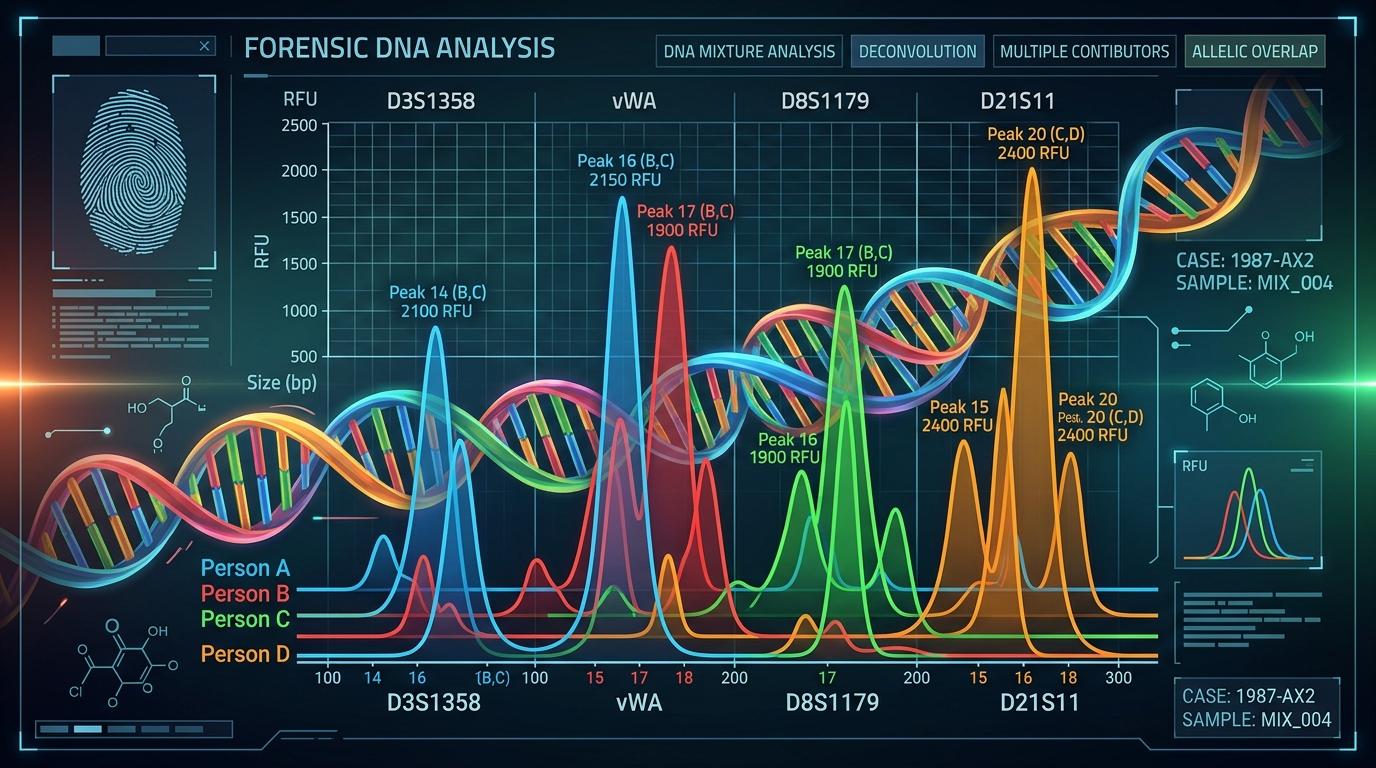
STR mixture interpretation software falls into two broad categories: inclusion/screening tools, which determine whether a candidate contributor's alleles are consistent with being present in a mixture, and probabilistic genotyping (PG) systems, which use statistical modeling to calculate a likelihood ratio for a specific contributor hypothesis, including for complex or low-level mixtures.
These are meaningfully different capabilities, and the distinction matters for how results should be used and reported.
What Is a DNA Mixture?
A DNA mixture occurs when a biological sample contains genetic material from more than one contributor, typically identified when multiple loci show more than two alleles. Mixtures are common in forensic casework — touch DNA, sexual assault evidence, and shared-surface samples frequently contain more than one person's DNA.
Inclusion / Screening Interpretation
Screening-level mixture tools determine whether a known candidate's genetic profile is consistent with being a contributor to a mixture — typically by checking whether the candidate's alleles are contained within the mixture's observed alleles, often against a defined inclusion threshold. This approach is well-suited to flagging plausible contributors and excluding implausible ones, and to prioritizing which mixtures need deeper analyst review. It does not, by itself, calculate a statistical weight for a specific contributor hypothesis in a complex mixture.
Probabilistic Genotyping (PG) Software
Probabilistic genotyping systems use computational statistical models — commonly Bayesian, Markov Chain Monte Carlo (MCMC)-based methods — to evaluate the likelihood of specific genotype combinations that could explain an observed mixture, accounting for factors like peak height, allele drop-out, and drop-in probability. This allows PG systems to calculate a likelihood ratio even for complex, low-template, or degraded mixtures that inclusion-based screening cannot statistically resolve. Well-known PG systems used in forensic casework include STRmix and TrueAllele, each requiring its own extensive developmental and internal validation given the complexity of the underlying statistical model.
Why the Distinction Matters
Using screening-level inclusion logic and describing its output with probabilistic-genotyping-level statistical language would overstate what the analysis actually supports — and could be challenged in court on exactly that basis. Conversely, not every laboratory or every mixture requires full probabilistic genotyping; many cases are well-served by fast, transparent inclusion screening, reserving PG analysis for the complex mixtures that genuinely need it. A laboratory (and its software) should be explicit about which category a given tool falls into, and reports should never imply a statistical weight the underlying method didn't actually calculate.
Frequently Asked Questions
Is inclusion-based mixture screening less scientifically valid than probabilistic genotyping?
No — they answer different questions. Screening determines whether a candidate's alleles are consistent with contributing to a mixture; probabilistic genotyping calculates a statistical weight for that hypothesis. Screening is appropriate when a statistical weight isn't needed or isn't reliably calculable for a given mixture.
Can screening-level software be upgraded to perform probabilistic genotyping?
Not simply as a feature update — probabilistic genotyping requires a fundamentally different, extensively validated statistical modeling approach, not an extension of inclusion logic.
Do labs need probabilistic genotyping software for every mixture case?
No. Many mixtures, particularly clear two-person mixtures with sufficient DNA quantity, can be reliably interpreted with inclusion-based screening; probabilistic genotyping is most valuable for complex, low-template, or degraded mixtures.
AlleleSight performs inclusion-based mixture screening and contributor flagging — it does not perform full probabilistic genotyping or mixture deconvolution, and is designed to be transparent about that scope so results are never overstated in a report.
See AlleleSight's mixture detection capabilities