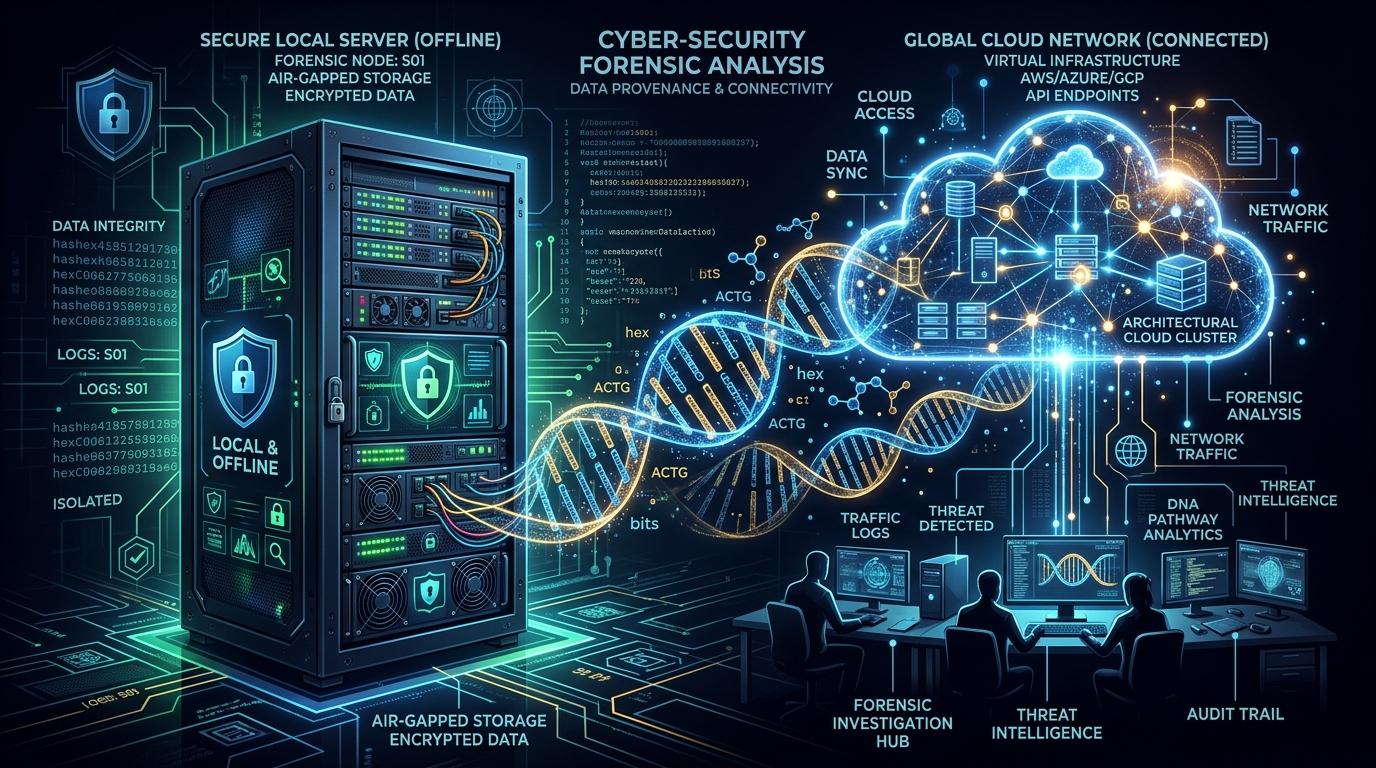
Offline (on-premise) forensic DNA analysis software processes and stores case data entirely on a laboratory's own local hardware, with no internet transmission required for routine analysis; cloud-based software processes or stores case data on infrastructure hosted by a third-party provider, accessed over the internet.
Each model involves genuine, different trade-offs for forensic laboratories — neither is universally correct.
Data Sovereignty and Chain of Custody
Forensic case data is evidentiary material subject to chain-of-custody requirements. Offline software keeps that data physically within the laboratory's own controlled environment at all times, which simplifies demonstrating that evidence was never transmitted to or processed by an external system. Cloud-based software requires the laboratory to extend trust to a third-party provider's infrastructure and security practices, which can complicate chain-of-custody documentation, particularly for laboratories operating under jurisdictional data-residency requirements.
Security Considerations
Offline software removes network-based attack surfaces for routine casework — there is no server to breach remotely, because there is no server involved in day-to-day analysis. Its security instead depends entirely on local safeguards: encrypted case storage, device-level access control, and physical security of the machine itself. Cloud software centralizes data on provider-managed infrastructure, which can offer strong security when properly implemented, but also concentrates risk — a breach at the provider level can potentially affect many laboratories' data simultaneously.
Accreditation and Audit Implications
ISO/IEC 17025 and forensic-specific standards such as ISO 21043 place significant weight on a laboratory's ability to demonstrate control over its processes and data. An offline deployment model gives an accreditation auditor a simpler system boundary to assess. A cloud deployment isn't disqualifying, but it does typically require the laboratory to also account for the provider's own security posture, data handling agreements, and geographic hosting location as part of its own accreditation evidence.
Reliability and Internet Dependency
Cloud-based software requires a working internet connection to function for routine use; offline software does not. For laboratories in locations with inconsistent connectivity, or laboratories that treat any external dependency as an unacceptable single point of failure for time-sensitive casework, this is a material operational difference.
When Might Cloud Make Sense?
Cloud-based tools can offer advantages for multi-site laboratories that need centralized case tracking across locations, easier software updates without local IT involvement, or workflows that specifically benefit from centralized data aggregation across a large laboratory network. The right choice depends on a laboratory's specific regulatory environment, IT resources, and risk tolerance — not a universal rule in either direction.
Frequently Asked Questions
Is offline forensic DNA software inherently more secure than cloud software?
Not automatically — security depends on implementation in both models. Offline software removes network-based attack surfaces for routine use, but still requires proper local safeguards like encryption and access control to be genuinely secure.
Can offline software still produce audit trails and support accreditation?
Yes — offline software can maintain full local audit logging; audit trail capability is a software design feature, not something exclusive to cloud deployment.
Does offline software mean no updates are possible?
No — offline software can still be updated, typically via a downloaded installer rather than an automatic over-the-network update, giving the laboratory direct control over when and how updates are applied and validated.
AlleleSight runs entirely offline by design — case data is processed and stored locally, encrypted, and never transmitted externally, with a full local audit trail supporting accreditation review.
Learn more about AlleleSight's offline architecture